


5 common small business website mistakes (and how to fix them)
Your website is online. The server responds, the navigation menu works and your service pages are published. And yet it doesn’t bring in business. It doesn’t attract qualified leads and it certainly doesn’t close sales.
The hard truth is that the vast majority of small business websites aren’t technically broken. They’re broken as a business tool. They’re conceived as static leaflets instead of dynamic conversion tools.
Let’s isolate and audit the five bottlenecks blocking your online revenue.
1. Your website talks about you, not your clients
The classic mistake of opening the hero (the top section of your homepage) with ‘We are a leading company in the sector with more than 10 years’ experience’.
Your client couldn’t care less about your company history or the year you were founded. When they land on your website, they only want to understand one thing in under three seconds: do you have the technical or professional ability to solve my problem?
If the first block on the page doesn’t make clear what you do, exactly who it’s for and what friction you remove, the visitor closes the tab and goes to a competitor. Your website isn’t the place to feed your corporate ego. It’s where you show the client, with sharp copy, that you understand their pain.
2. You don’t have a clear conversion goal
Plenty of small business sites just dump information. The visitor arrives, scrolls, reads three paragraphs and reaches the footer with no idea what the next logical step is. You’ve built a dead end.
Without a defined conversion funnel and a highly visible call to action (CTA), whether that’s asking for a quote, booking a consultation or going to the checkout, all the traffic you manage to attract is useless.
Every URL in your project should have a transactional goal. If the client has to think, work it out or dig through the menu to find how to contact you, assume the sale is lost.
3. The design doesn’t inspire trust
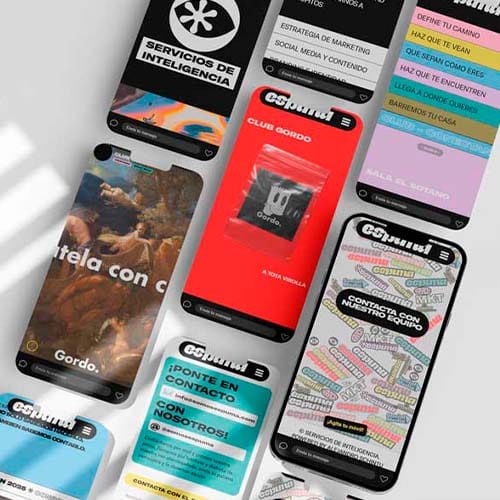
Interface design (UI) isn’t about looks or ‘making it pretty’. It’s about perceived value, authority and trust.
Heavy use of prefabricated templates, colour palettes chosen without regard for accessibility and messy layouts all say improvised and low-budget. In the first milliseconds, the visitor scans the page and decides whether you’re a professional option or a company not to be trusted.
If the visual design is generic, has no branding or looks dated, your credibility nosedives. To avoid that, it’s essential to go for custom web development, with clean code and a visual structure that backs up your prices and your level of service. Without credibility, nobody leaves you their details or their card.
4. Slow, confusing and with no visual hierarchy
This is where we get into performance and WPO (Web Performance Optimisation). If your page takes more than 2.5 seconds to render (high LCP), the bounce rate shoots up. Google’s Core Web Vitals measure that delay with millimetre precision, but your client penalises you long before that by closing the tab. Keeping those numbers in check is the job of good WordPress maintenance.
Visually, the knock-on problem is chaos: pages where every block, image and font has the same size and importance. If you don’t apply a strict visual hierarchy, using contrast, white space and type weights that guide the eye straight to the conversion point, the visitor drowns in noise and leaves.
5. It isn’t built for mobile or for ad campaigns
Designing and checking a website only on a 27-inch monitor and letting the mobile version ‘sort itself out with CSS’ is the fastest way to wreck your conversions. Today most of your traffic arrives from a smartphone, and in B2C it’s usually even more.
The most serious financial mistake a small business makes is spending thousands of euros on ad campaigns (Google Ads, Meta Ads) and sending all that paid traffic to a homepage that isn’t optimised for mobile conversion. Overlapping elements, buttons impossible to tap with a finger or hidden menus. Sending traffic to a website like that is literally burning your ad budget.
Web development for small businesses: how to fix it without rebuilding from scratch
You don’t always need to bin your server, wipe the database and set up a new system. Often it’s enough to audit the bottlenecks and apply strategic fixes through in-depth technical web consultancy:
Audit the message: Swap empty corporate copy for direct copy focused on what you solve.
Map the critical path: Define a single main action per URL and clear out every element that distracts from it.
Clean up the UI: Remove visual noise and organise information using interface design principles (sizes, contrast and hierarchy).
Technical WPO optimisation: Bring down server response time (TTFB), defer blocking JavaScript and make sure the mobile experience is smooth and responds instantly.
Measure and iterate: Make continuous improvements based on events and real browsing data, never on hunches.
Why your business needs a website (and not just social media)
Because it’s the only channel you control. Social networks change your reach whenever they like, directories show you right next to your competitors and your Google profile only gives a phone number. Your website is where people looking for you check you exist, understand what you do and contact you with no middlemen. That’s what a website is for: not just to be there, but so the decision to call you happens somewhere that’s yours.
What to ask a small business web designer
Before you hire, ask for three things. Case studies with measured results, not just pretty screenshots. A plan for your business goals, not a template with your logo on it. And who looks after the website afterwards. A small business web designer who can’t answer those three questions will hand you another online leaflet. If you want to see how I answer them, it’s all on my web design for small businesses page.